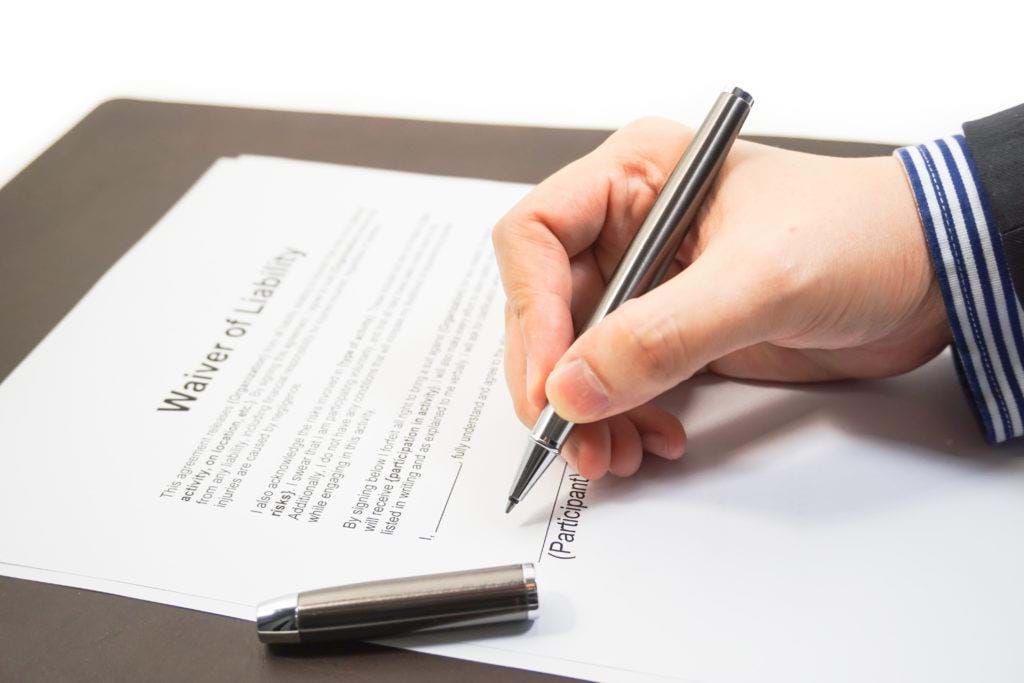
With employees returning to work and companies reopening their businesses to customers, visitors and guests, businesses are looking for ways to limit liability related to potential COVID-19 claims. To do so, many are considering waivers for customers and visitors. In the context of employees, waivers for alleged workplace COVID infections will be invalid, as state workers compensation statutes require employers to pay medical expenses and lost wages to employees injured in the course and scope of their employment. With respect to third parties, liability waivers can be an effective tool to avoid potential liability for damages related to COVID-19.
Visitor Waiver
We have prepared a Visitor Acknowledgment and Waiver that you can use for customers, guests and visitors to protect against claims from these parties related to COVID-19 exposure while on your premises. The waiver not only provides a release of all claims against you related to COVID, it also provides a mechanism for you to confirm that the visitor is not currently experiencing any symptoms of COVID and has not been in close contact with someone who has tested positive. Finally, the waiver also requires the visitor to agree to abide by all mitigation measures in place at the location while on your premises (e.g., face masks, social distancing, etc.).
One caveat is that waivers for pandemics, and specifically COVID-19, have not been interpreted by the courts. It is possible that some jurisdictions will be unwilling to enforce such waivers as against public policy. It is likely that the same states which categorically refuse to enforce waivers of personal injury claims and/or generally look with disfavor on such waivers/releases would be equally unwilling to enforce a COVID-19 waiver. Finally, it is important to note that no waiver will ever operate to relieve a client from liability for its gross negligence or willful neglect.
A waiver or other attempt to limit liability should also not be used as a replacement for maintaining a safe workplace. In order for businesses to place themselves in the best position to have these waivers enforced by a court and to prevent the court from citing to public policy concerns as an obstacle to enforcement, businesses should ensure compliance with the safety protocols outlined in local orders, state regulations and guidance from government agencies like the Centers for Disease Control (“CDC”) and Occupational Safety and Health Administration (“OSHA”).
Waiver, Release and Indemnification Agreement
With respect to the contractual agreements you have in place with other parties, we have provided three different versions of a Waiver, Release and Indemnification Agreement specifically related to COVID-19 to use with your subcontractors, vendors and/or tenants.
- COVID-19 Waiver, Release and Indemnification Agreement for Contractors
- COVID-19 Waiver, Release and Indemnification Agreement for Tenants
- COVID-19 Waiver, Release and Indemnification Agreement for Vendors
Since no company will be able to waive the rights of its employees to bring a claim against you in the event that an employee contracts the virus and later alleges that he/she became infected while at your jobsite or otherwise on your property, this Agreement documents that the subcontractor, vendor or tenant (“Subcontractor”) is responsible for the implementation and enforcement of all site-specific COVID-19 safety procedures. It also then provides an update to any pre-existing indemnification provision that may be present in your current agreement to add a requirement that the Subcontractor defend and indemnify you for all claims brought by its employees relating to an actual or alleged exposure to the virus.
Resuming operations in the midst of a national pandemic is certainly unchartered territory for businesses. Dozens of coronavirus-related lawsuits have already been filed nationally against businesses. As such, businesses must do all that they can to protect themselves. That begins with the development and implementation of appropriate safety procedures and protocols, which incorporate the guidance issued by the CDC and OSHA to help protect the safety and welfare of your employees and visitors to your property or jobsite. Once these safety procedures are in place, these agreements are an additional tool to help protect your organization for liability claims from third parties who claim that they contracted the virus notwithstanding your safety practices. We encourage you to review these templates and discuss their use with your Graham Company Account Management Team and Safety Consultant.
Since we are not your attorneys, we strongly recommend that you have your Corporate Attorney review our suggested templates to be certain that they are properly written and legally acceptable/enforceable.

Philadelphia, PA, 19102


